
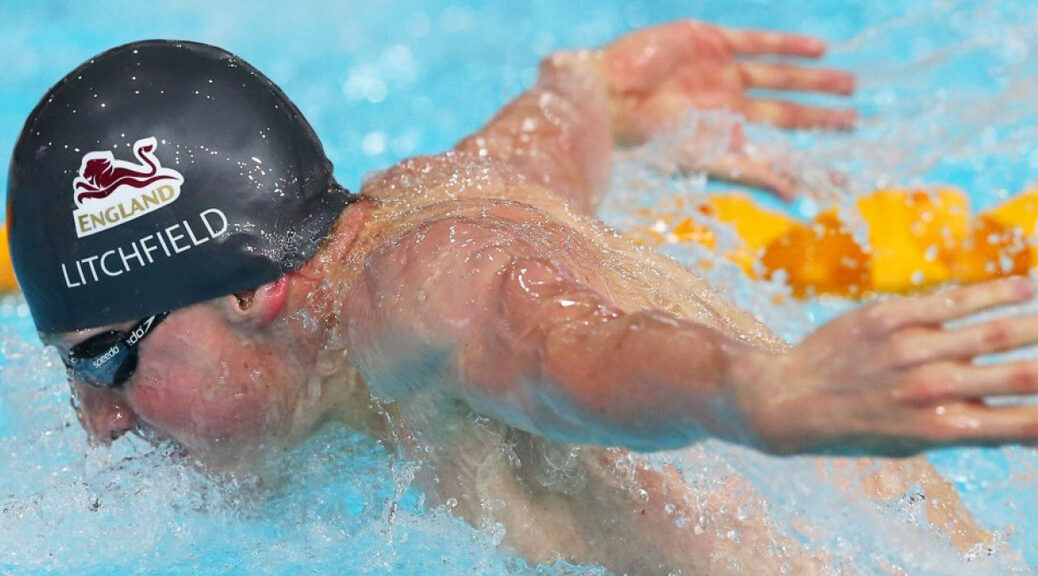
With the 2026 Commonwealth Games heading to Glasgow, Swim England has laid out a familiar multi-step selection process which provides the basis for building the team that will head north of the border in the summer. While there is a lot going on, from early long lists to trials performances and, as usual, discretionary picks, selection for Team England will follow a familiar path. Here’s how it all fits together.
The total squad size is capped at 43 athletes, split between:
- Up to 28 swimmers
- Up to 15 para-swimmers
The two groups have very different criteria. For able-bodied swimmers, selection unfolds across four stages as follows, with two already completed. It’s worth remembering that selection really means nomination since Commonwealth Games England need to ratify the team put forward, but historically this has mainly been a rubber stamping exercise, unless there have been changes to the allowable team size.
Step 1: Long List Nomination
Everything started here. Swim England compiled a long list of eligible athletes last year— in theory the only pool from which final selections can be made. So inclusion is essential but it guarantees nothing; think of it as the entry ticket to the selection race.
Four years ago this group was named as the England Team and comprised 85 athletes, but there has been no official word on the list this time round. Given the size of the group last time round it seems unlikely that this will be a showstopper for any realistic Glasgow hopefuls, especially as the long list can be amended up to the Commonwealth Games England selection deadline. With that in mind this step is largely superfluous.
Step 2: Pre-Selection at the 2025 World Championships
Perform at the World Championships, and you could fast-track your way onto the team with individual medallists being pre-selected subject to proving fitness at trials. Or at least they would have been preselected if there had been any individual medallists in Singapore still eligible – the only swimmer who might have taken advantage is Ben Proud but he’s persona non grata now and so no spots are filled here, leaving all 28 up for grabs in the next stage.
Step 3: The Trials – Make or Break
This is the real moment to stake a claim, and in reality the only one that swimmers can influence themselves. Up to 20 swimmers will be nominated directly from performances at the Aquatics GB Championships in London. Selection is based on:
- Individual Events – Hit or beat the published consideration times listed below in any final, with priority given to A final performances
- Relay Selection – The usual combination of the top four English swimmers across all 100m/200m finals, with priority again for the A final, for the freestyle relays and the top English swimmers in each stroke, from the A finals only, for the medley relays.
| Male | Event | Female |
|---|---|---|
| 00:21.95 | 50m Freestyle | 00:25.09 |
| 00:48.13 | 100m Freestyle | 00:54.05 |
| 01:46.12 | 200m Freestyle | 01:57.08 |
| 03:48.34 | 400m Freestyle | 04:08.82 |
| 07:56.81 | 800m Freestyle | 08:36.96 |
| 15:19.33 | 1500m Freestyle | 16:26.99 |
| 00:25.22 | 50m Backstroke | 00:28.22 |
| 00:53.77 | 100m Backstroke | 00:59.88 |
| 01:57.62 | 200m Backstroke | 02:10.17 |
| 00:27.64 | 50m Breaststroke | 00:30.90 |
| 01:00.10 | 100m Breaststroke | 01:07.22 |
| 02:12.21 | 200m Breaststroke | 02:24.49 |
| 00:23.44 | 50m Butterfly | 00:26.36 |
| 00:51.66 | 100m Butterfly | 00:58.14 |
| 01:56.81 | 200m Butterfly | 02:10.00 |
| 01:58.61 | 200m Individual Medley | 02:10.99 |
| 04:15.40 | 400m Individual Medley | 04:40.32 |
| 03:17.29 | 4 x 100m Freestyle Relay | 03:41.81 |
| 07:12.14 | 4 x 200m Freestyle Relay | 08:03.75 |
| 03:37.93 | 4 x 100m Medley Relay | 04:01.13 |
The consideration times are quick, but not excessively so, and it should be the case that there are individuals under them in most events. Anyone who makes those times (including the relays) are then ranked by percentage inside the consideration time to determine selection priority. In short, it’s not just about getting the time it’s also about how fast you are relative to the standard and given the relatively small number of spots in play, and the likelihood of most events generating qualifiers, there could be some disappointments here.
Step 4: Discretionary Selections
Once the main selections are done, the selection panel led by head coach Andi Manley can fill any remaining spots. With the meet taking place just north the border it seems unlikely that any spots will be left empty, but this is where some nuance could come in. The factors stated as being considered by the panel include:
- Medal potential
- Potential Relay Contribution
- Number of consideration times achieved
- Commonwealth Ranking on a top 3 per nation basis
These picks could be employed to build relay depth or to give experience to emerging athletes, but as in the past, may well just mean picking the next cabs off the rank from the percentages. While left field selections are not unknown, it would be a surprise if, apart from maybe bolstering relay alternates, the extras are not just the next few swimmers on the priority list.
However this is also the chance to mitigate any injury implications and is the element that Tom Dean will be relying on since he’s missing London with a shoulder injury. It seems unthinkable that he won’t be in Glasgow if fit so expect his name to be added here.
The Para-Swimming Selection Process
The para pathway is dependent on international qualification systems, with two main stages. The first is the same longlisting process as above, but then Para-swimmers must earn a slot via World Para Swimming (WPS) and the Commonwealth Games Federation (CGF). There are two possible routes:
Route A: WPS Commonwealth Ranking List
Athletes ranked in the top 7 (max 3 per nation) after a qualification window running from January 2025 to February 2026 may earn slots, which are allocated by name and are non-transferable. If more than 15 English swimmers qualify, prioritisation will be made on a discretionary basis considering medal potential, prior international performances, and event depth.
Route B: Bipartite Invitations
A smaller number of discretionary slots are awarded by a joint panel drawn from the CGF and WPS considering development athletes, managing global representation, the strength of event fields and any exceptional circumstances If invited, athletes may be nominated at the panel’s discretion.
This process is already complete, but the team has not yet been made public.
Banner Image: Team England